
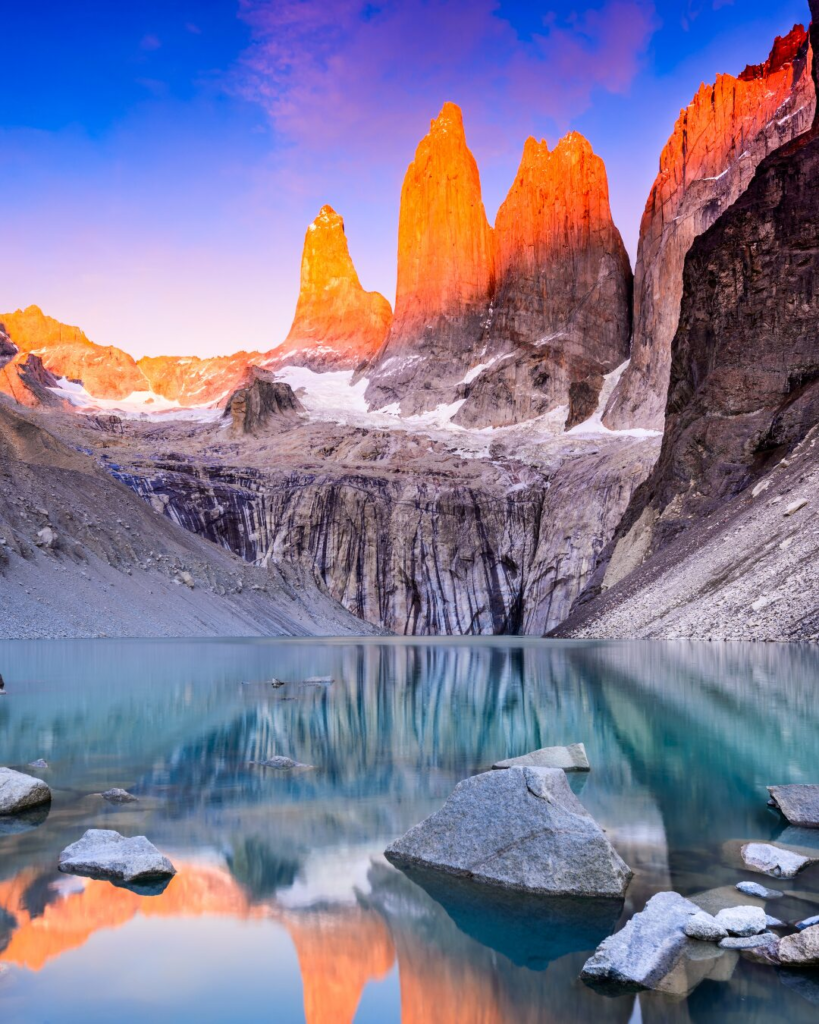
Patagonia luxury travel begins at the end of the world, and that's very much the point. The southernmost tip of South America, shared between Chile and Argentina, produces a landscape dramatic enough that it's become shorthand for a certain kind of aspiration: the granite towers of Torres del Paine rising 9,000 feet above a turquoise lake, the Perito Moreno Glacier advancing six feet a day into Lake Argentino, calving with explosions audible from a mile off, wind on the open steppe that's permanently bent the trees eastward.
It's not an easy destination, and it isn't meant to be softened into one. Four seasons in a single day isn't a cliché here, it's the actual forecast, and the best hikes demand real physical preparation. What makes Patagonia work for a client who's already seen the more forgiving parts of the world is exactly that intensity, paired with the right support around it: a private guide who reads the weather correctly, a lodge positioned for the view rather than convenience, and a pace built around the client's fitness rather than a group's average.
That combination, raw landscape plus considered logistics, is what separates a trip through Patagonia from a trip that merely passes through it. The glaciers and granite spires don't need embellishing. They need someone making sure you're on the right trail at the right hour, with transportation and lodging arranged so the physical demands of the place don't become logistical headaches on top of them.
At a Glance
Patagonia spans the southern cone of South America, split between Chilean Patagonia (Torres del Paine, Punta Arenas, the Carretera Austral) and Argentine Patagonia (Los Glaciares National Park, El Calafate, El Chaltén, Tierra del Fuego). Punta Arenas and El Calafate serve as the two primary bases, with Puerto Natales as the gateway town into Torres del Paine itself. A private driver or transfer between these points turns what could be a logistical scramble into an easy, scenic leg of the trip.
Travel Offerings
- Custom Private Travel
- Trekking & Hiking Expeditions
- Glacier Experiences
- Small Group Adventure Travel
- Sailing & Marine Expeditions
Travel Guide
- U.S. citizens need a valid passport; no visa required for Chile or Argentina for stays up to 90 days in each.
- Currency is the Chilean peso (CLP) in Chile and the Argentine peso (ARS) in Argentina.
- Punta Arenas (PUQ) and El Calafate (FTE) are the main regional airports, with standard internal flights from Santiago and Buenos Aires.
- Weather-appropriate gear is non-negotiable: waterproof layers, sturdy boots, wind-resistant outer shells, regardless of season.
- The W Trek (5 to 7 days) and the O Circuit (8 to 10 days) require hut or campsite bookings through CONAF, Chile's park administration, months in advance; a private guide handles this logistics chain rather than leaving it to the client.
- Torres del Paine's W Trek: the Torres lookout (a 5-hour round trip to the granite towers above a moraine lake), Valle del Francés (hanging glaciers ringing a rock amphitheater), and the Grey Glacier, a 3-mile-wide ice field reachable on foot or by private boat.
- Mirador Las Torres at sunrise, when the granite towers turn pink in the first light, best timed with a private guide who knows the exact window.
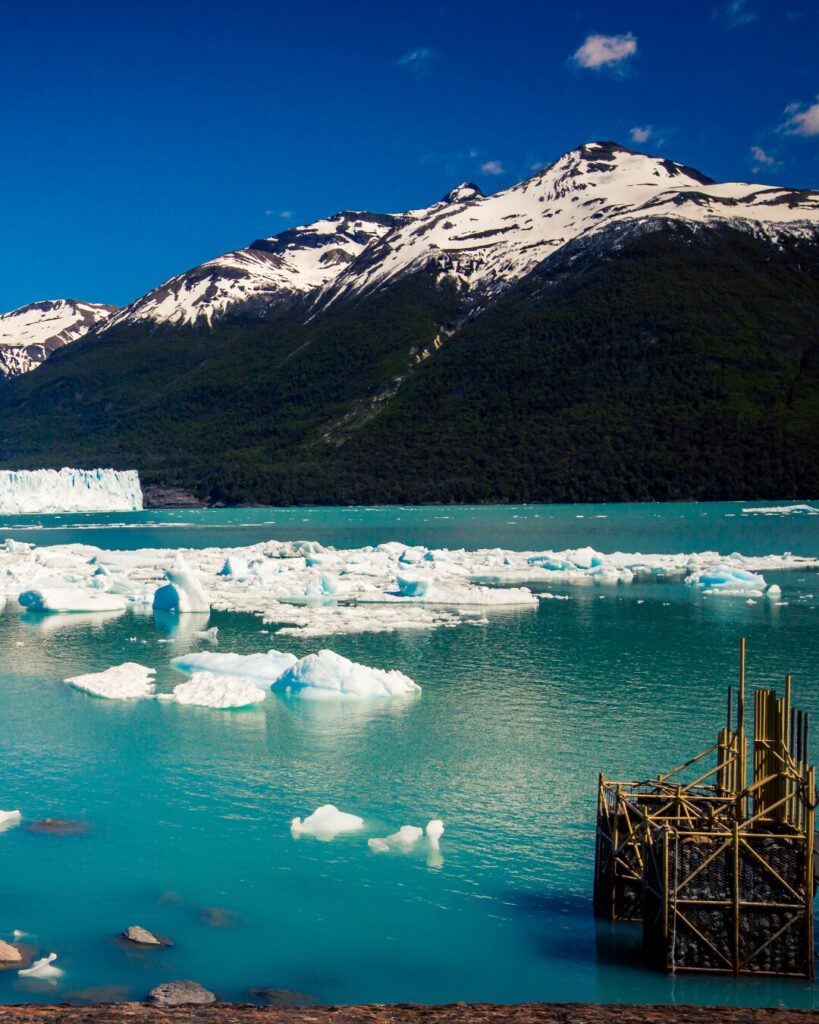
- Perito Moreno Glacier in Los Glaciares National Park: a walkway system along the moraine offers views of the 200-foot ice cliff from multiple angles, with guided ice trekking on the glacier surface itself using crampons.
- El Chaltén, Argentina's trekking capital, sits at the base of Mount Fitz Roy (11,171 feet). The Laguna de los Tres trail, six hours round trip, ends at a moraine lake with Fitz Roy reflected directly overhead, one of Patagonia's defining images.
- Argentina ranks among the most LGBTQ+-inclusive countries in South America; same-sex marriage became legal in 2010, and Buenos Aires holds one of the most vibrant LGBTQ+ communities in Latin America.
- El Calafate and El Chaltén are relaxed tourist towns where the international visitor base creates a naturally inclusive atmosphere.
- Chile legalized same-sex marriage in 2022. Punta Arenas and Puerto Natales are smaller and lack dedicated LGBTQ+ infrastructure, but carry no documented hostility.
- The trekking environment itself functions as fairly neutral ground; the international mix of hikers on the major routes makes it reliably welcoming in practice.
- October through April is Patagonia's summer and the practical trekking window.
- November and March are shoulder months: strong odds of good weather with noticeably fewer hikers on the trail.
- December through February is peak season, with January bringing up to 17 hours of daylight at this latitude, but also the most crowded trails and huts, which is exactly where private guiding and pre-arranged lodging matter most.
- W Trek huts fill up 6 or more months ahead for the December through February window.
- April brings the lengas (southern beech trees) turning gold and orange, with crowds thinning fast.
- Winter (May through September) closes most of the park entirely.
7-Day Itinerary
Torres del Paine & Perito Moreno
Day 1 — Arrive Punta Arenas / Puerto Natales
Fly into Punta Arenas (via Santiago). Drive 3 hours north to Puerto Natales — the gateway town for Torres del Paine. Evening briefing on gear and weather expectations.
Day 2 — Torres del Paine: Base Torres Hike
Enter the park at dawn. Mirador Las Torres hike: 10 miles round-trip, 3,300 feet elevation gain. The granite towers at the top — three vertical spires rising above a moraine lake — at first light (the pink color lasts 15–30 minutes). Return by late afternoon.
Day 3 — Valle del Francés
Boat transfer to Paine Grande, hike the Valle del Francés: a glacial hanging valley flanked by peaks and hanging glaciers that calve throughout the day. The mirador at the valley head delivers the classic Torres del Paine panorama.
Day 4 — Grey Glacier
Hike to Mirador Ferrier above Lake Grey — the view of the glacier from above puts its scale (3 miles wide, 30 square miles total area) into perspective. Optional ice trek on the glacier surface with crampons.
Day 5 — El Calafate, Argentina
Drive east through Chile toward the Argentine border. Cross at Cerro Castillo and drive to El Calafate (5–6 hours total). Afternoon at leisure.
Day 6 — Perito Moreno Glacier
One-hour drive to Los Glaciares National Park. The walkway circuit above the glacier — the 200-foot ice wall advances 6 feet per day. Calving events happen unpredictably and constantly; plan 3–4 hours on the walkways. Optional: ice trek with crampons on the glacier surface.
Day 7 — El Chaltén / Depart
Drive north to El Chaltén (3 hours) for a brief orientation hike to the Fitz Roy viewpoint (90 minutes each way). Fly home from El Calafate via Buenos Aires.
Travel Insights
Sorry, we couldn't find any posts. Please try a different search.